
According to research in the publication Supply Chain Quarterly, companies whose supply chain performance ranks in the top 25 percent have market capitalizations between 1.7 and 3 times higher than the industry average. Leaders can increase revenue and margins, reduce operating expenses, adapt more quickly to changing markets, and meet customer needs more precisely than others.
As the COVID-19 pandemic has shown, companies need the ability to quickly identify shortages, demand spikes, and supplier disruptions to win and keep customers as conditions change.
But how do you achieve and sustain an intelligent and responsive supply chain as connections grow more intricate and disruption becomes the norm?
The supply chain digital twin
In a Deloitte study, 76 percent of supply chain leaders say that developing digital and analytics capabilities is very important to their strategy.
But simply being able to analyze and report on supply chain characteristics is only the beginning. Organizations can achieve significant competitive advantage by adopting the model of the digital twin.
In its ideal form, a digital twin is an accurate, real-time virtual model of a real-world object or system. Originally, digital twins were developed for product design and simulation using accurate 3D models. Today, modern data approaches and advanced analytics delivered from the cloud have led to digital twin technology that can do more than simply mirror key processes within physical assets.
Now, a digital twin strategy can be used to model complex processes that combine physical, digital, and process components—which makes it ideal for modernizing supply chain management and providing a new level of control tower functionality to the business.
This will allow you to have complete visibility across all levels of supply chain, from granular inventory to large-scale shifts in demand. Combined with IoT, machine learning, and AI, the digital twin can proactively offer predictions and recommendations, enabling further efficiency and resilience.
Ultimately, a digital twin is not just about what happened yesterday, or what’s happening today. It allows you to model scenarios to optimize for tomorrow, whether it’s changing manufacturing lines, ensuring the right people and assets are available when and where they are needed, or reducing risk by creating redundancy in critical areas. Using big and small data in combination with automation enables the supply chain to increase agility where it is most needed, such as optimizing production schedules.
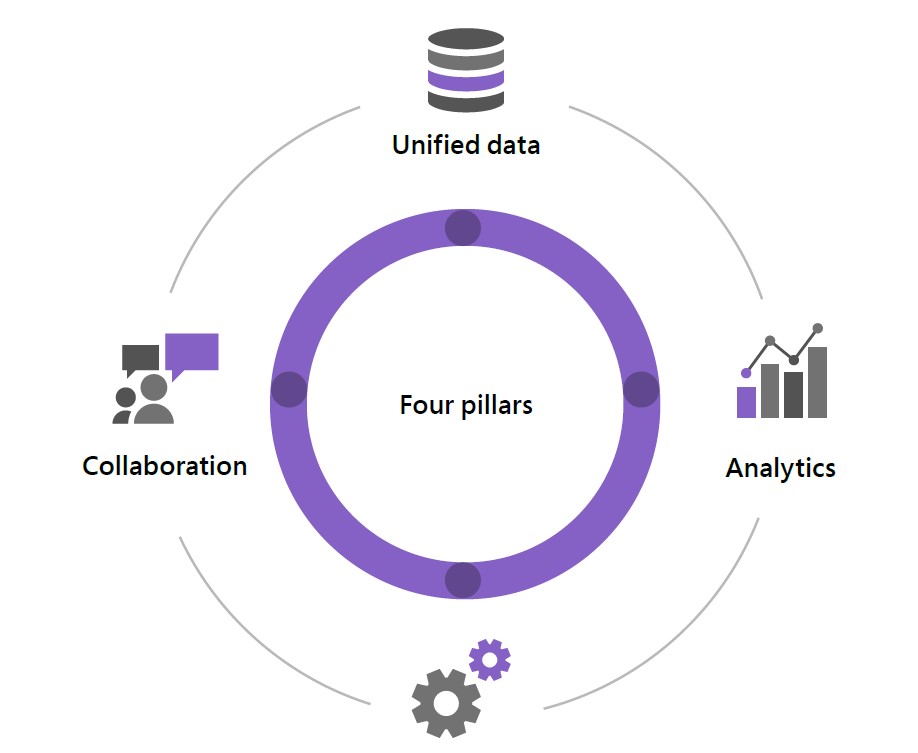
The four pillars of the supply chain digital twin
While developing these capabilities may seem daunting, in reality, modern cloud technology makes it possible to start the journey using data you already have. You’re not building a new supply chain—just making the one you have more intelligent.
There are four key elements necessary to creating a true supply chain digital twin. In the following sections, we’ll look at each one and provide details on how they are accomplished.


Leave A Comment