
Due diligence now helps drive predictable success in the future.
Embrace DevOps and automation
Traditionally, the process to manually release a change to applications was convoluted, involving several teams, change boards, manual regression tests, and approvals. It took weeks. This complexity makes teams averse to change. Enhancements and updates are then consistently deferred, which affects the adaptability of your applications to shifting business and technology priorities. Automating builds and releases and building in testin automation is crucial to allow for continuous software updates.
The biggest selling point of the cloud is to stay current and quickly deploy software. You can’t rely on teams to manually test and deploy each and every change to achieve that vision.
Traditionally, a time lag existed between code and test and deploy. A bug in production meant repeating the lengthy cycle. The fear of breaking code meant that teams tended to delay updates for as long as possible. With automation, you deploy fast and potentially fail fast. This is where the culture of fail fast comes in. Automated processes help companies empower their teams to take risks. You fail but quickly release a fix. Over time, failures decrease and success rates improve, instilling confidence in teams to deploy and innovate, and delivering value to the business faster. At the core of the cloud mindset is understanding and embracing DevOps. DevOps is the union of people, process, and technology to continually provide value to customers. DevOps is a cultural change in which we break down silos between developers and administrators, and create shared responsibility for the quality of released software. The DevOps process automates software delivery and speeds up the technology deployment lifecycle.
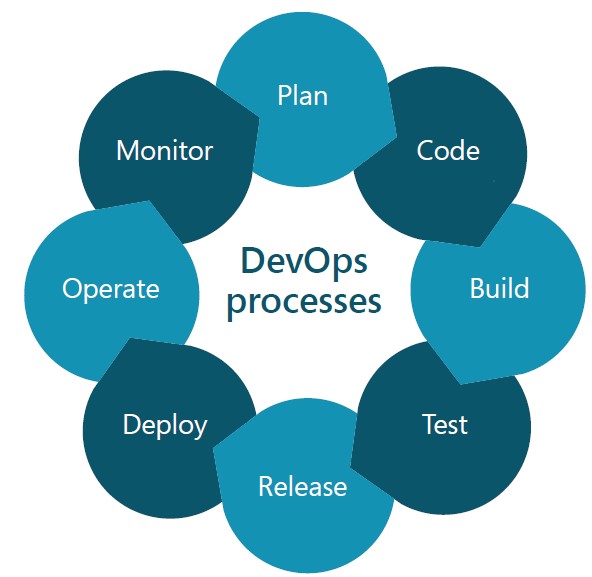
Dynamics 365 offers deep integration with Azure DevOps with build tools to help automate your deployment pipeline and effectively manage the application lifecycle.
The idea is to enable development, IT, and quality and security teams to collaborate to produce more reliable and quality products with the ability to innovate and respond more quickly to the changing needs of business. Implementing DevOps inherently depends on automation: automating the build process to enable continuous deployment, regression tests to improve speed and reliability, and administrative actions like user and license management.
At this point, we should also explore continuous integration (CI) and continuous delivery (CD) in the context of the cloud. The idea is each code check-in from the developer should go into the main build and get tested early. This takes CI to the next level by allowing for automated testing and continuous, automated code deployment.
If a change includes a bug, the build fails, and the cycle repeats. The automation allows for changes to happen quickly without unnecessary overhead—a team can focus on the business logic and not the infrastructure. Therefore, with CD we always have the most up-todate working software.
CI and CD bring agility to cloud solutions by allowing for the latest changes and bug fixes to move to production code without delay. This is a paradigm shift from the world of on-premises software, in which each change had to wait until all user stories were completed, the full package was deployed, and a testing team tested the change. With automation, we’re reducing time and improving quality.
But this isn’t just a technological change. DevOps requires close collaboration between development, testing, and deployment teams. This is a cultural and mindset change in which the whole team trusts each other, feels empowered, and is collectively responsible for product quality.
Preparing your organization for the fast-paced world of the cloud means that automation isn’t optional anymore. Instead, investments in automation will deliver significant efficiencies and help improve the overall reliability of your applications.

Leave A Comment