
Driven by data
This disruptive innovation we’re seeing across several industries is fueled by data. Almost everything around us generates data: appliances, machines in factories, cars, apps, websites, social media. What differentiates one company from another is the ability to harness this data and successfully interpret the information to generate meaningful signals that can be used to improve products, processes, and customer experiences.
Organizations recognize data is an asset, and becoming data driven is a key motivator for digital transformation. Still, the accounting rigor that we see in finance is seldom observed when it comes to managing organizational data. If data is the new currency, then we should treat it like that. Get an understanding of your organizational data estate—the databases, data warehouses, and data lakes — that help your company manage its corporate data. Develop a holistic view of customer data across departments, functions, and applications, while acknowledging the regulatory boundaries on data usage. These steps are practically a prerequisite to digital transformation.
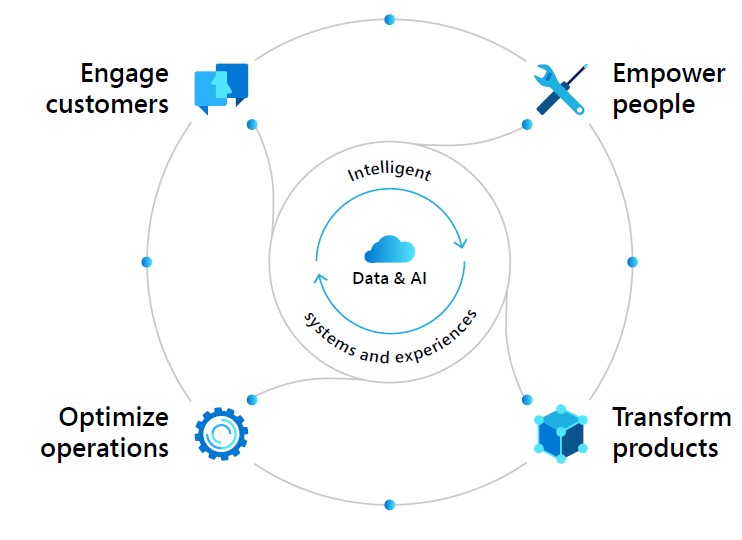
Depending on the volume of data, its age, and organizational silos, the deduplication, correlation, and conflation of data from different systems could become a complex project on its own.
However, modern AI-powered customer data platform (CDP) technologies could come to the rescue. A CDP technology creates a persistent, unified customer database that is accessible to other systems. Data is pulled from multiple sources, cleaned, and combined to create a single customer profile. It’s also important to define your organizational data strategy for business applications, develop guidelines on how new applications store their data, what schema they use, and how other applications in the organization can understand and use this data. You need to use the most optimal datastore for your use case. For example, storing credit card transactions in Dataverse (a repository to store and manage data used by business applications) is suboptimal; a data lake might be a better choice.
Being data driven is about better understanding your data’s quality and relevance, and being able to generate valuable insights that are actionable and can drive meaningful changes to your processes. Going back to the point of embracing change, your data strategy should reflect how you design your process, develop your applications, and operate. If it takes several months to deploy a change request or years to roll out an improved process, there is little point.
A data-driven business application cloud platform like Dynamics 365 enables you to:
▪ Create a data estate that is intelligent and AI-ready
▪ Connect and consume data from legacy on-premises systems, other line of business applications, and third-party applications
▪ Have the necessary controls to secure and meet data compliance requirements
▪ Build smart applications that are continuously improving
▪ Infuse data intelligence directly into the application, empowering users to make effective and smart decisions
▪ Have agility so applications can quickly adapt to changes in your process
Overall, the intelligence and insights you generate from your data will be proportional to the quality and structure of your data.
You’re investing in the platform, not just the application.
Think platform
An organization can take several approaches towards digital transformation. In many cases, you start with a single application being deployed to a SaaS cloud. A key responsibility of IT decision-makers and enterprise architects is to deliver a cloud platform for their organization’s digital transformation. Individual applications and their app feature sets are important, but you should also look at the larger picture of what the cloud platform offers and what its future roadmap looks like. This will help you understand if the platform can meet the short-term and long-term objectives of your digital transformation.
Thinking about the platform versus a single app offers clear benefits. You avoid reinventing the wheel with each additional application, and you instead deliver a foundation approved by governing bodies, with clear patterns and practices. This approach limits risk and brings a built-in structure that enables reuse. Platform thinking doesn’t necessarily mean that other cloud platforms or legacy applications have to be rebuilt and replaced. Instead, you can incorporate them as part of an all-encompassing platform for your organization, with well-defined patterns and swim lanes that enable integration and flow of data between applications. Bringing this “systems thinking” to deliver a platform for business applications can drastically reduce the amount of time lost getting security and design approvals for individual apps, thereby improving your agility and time to value.
Your business applications platform should already provide the following:
▪ Necessary security and design approvals for processing data in specific categories based on its sensitivity and regulatory requirements
▪ Clear guidelines on extending and customizing the platform to ensure supportability and agility
▪ Established governance process to manage access and service operation
▪ Approved integration patterns for communication with other platforms and on-premises systems, with a clear process for approving deviations
▪ Data storage guidelines for apps and patterns for sharing
▪ License entitlements that are available for individual apps
▪ Documented service protection limits and best practices that your applications should comply with
▪ Resources for additional learning and guidance with access to experts
The due diligence and foundational work you do when choosing a platform in coordination with IT and business decision-makers can save weeks, if not months, of effort downstream when developing individual apps. This thorough evaluation also helps drive predictable success.

Leave A Comment